

More Than Names
Learning Indigenous law through Indigenous place names reclamation
Earlier this year, we released a Yellowhead Institute Special Report on the “Rematriation of Indigenous Place Names”.1 The Report explains that reclaiming Indigenous place names is not merely a matter of changing geographic toponyms. It is a legal, cultural, historical, and linguistic process rooted in Indigenous laws and relationships to land.
For centuries, many Indigenous place names were erased and replaced by colonial ones.2 Indigenous peoples throughout Canada are actively reclaiming these names. In this article, we describe these processes as starting points for learning Indigenous law, language, and land through Indigenous place names.
Language and Law
Language places legal norms, values, and histories onto the places around us. Indigenous place names, for example, inscribe stories, territorial occupation, rights, and responsibilities onto the land. For many Indigenous peoples, place names are deeply intertwined with Indigenous law. By pairing language with law, they create cultural and legal expectations reaffirmed through governance, including potlatches and feasts.
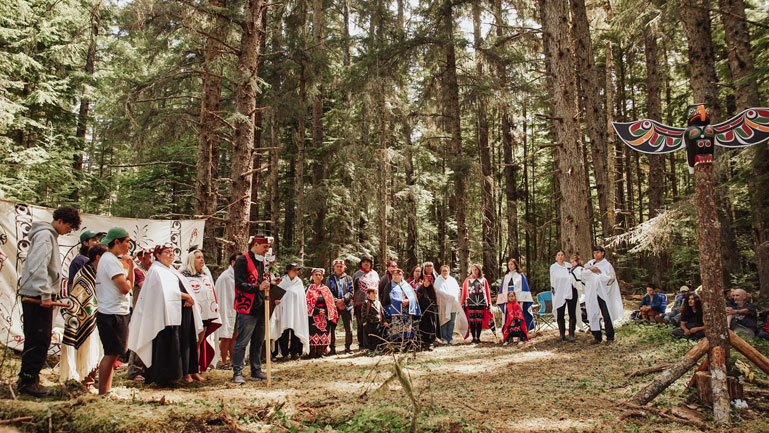
Hiladi - Photo Credit: Desiree Wallace
Rematriating Place Names
Place names provide insight into Indigenous law, and so do the processes used to reclaim them. In our Report, we argue that restoring Indigenous place names occurs through rematriation,3 including correcting past harms, restoring authority, and honouring leaders whose authority has been silenced. This includes restoring and affirming the authority of Indigenous women and 2SLGBTQIA+ leaders in Indigenous law, culture, and governance.
Reclaiming Indigenous languages and laws without restoring the rightful authority of all community members is not enough. Rematriation requires ensuring that no one is left behind in the work of setting aside harmful decisions and making things right.
These decisions about place names are guided by Indigenous legal processes and may be:
- Corrective: substituting an incorrect or misleading name with an accurate one
- Restorative: placing a name that addresses harms and restores those impacted
- Instructive: placing a name that creates expectations for future conduct
These legal principles can be identified in processes throughout Canada in which Indigenous peoples are actively engaged in the reclamation of place names.
For example, in 2024 and 2025, multiple street names commemorating Bishop Vital-Justin Grandin were changed in Winnipeg, Manitoba. Grandin played a key role in implementing residential schools. In Winnipeg, a naming council guided the process with youth, Elders, Knowledge Keepers, and residential school survivors.4 These new names include:5
- Abinojii Mikanah: “children’s way” in Anishinaabemowin (Ojibwe)
- Awasisak Mēskanôw: “children’s road” in Cree
- Taapweewin Way: “Truth” in Michif.
The naming council’s composition demonstrates making things right without leaving people behind. Its decisions are restorative because they honour children, and are corrective and instructive because they replace harmful commemorations with names that inscribe truth onto the land.6
The Winnipeg process is a powerful example of how place name reclamation can operate as a remedial process, and forms part of a broader movement underway across Canada.
For instance, in 2020, a group of seventeen women known as iyiniw iskwewak wihtwâwin, or the Indigenous Women’s Action Movement, worked with the City of Edmonton to place Indigenous names on its electoral districts. After consulting Knowledge Keepers, the group proposed twelve names, which Edmonton City Council made official by bylaw within months.7 iyiniw iskwewak wihtwâwin’s consultation illustrates one way to meet procedural obligations within Indigenous law. It also shows that place naming can occur in efficient, tailored, and community-grounded ways.8
These renaming processes are also occurring in British Columbia. For example, the Haida Nation is on a decades-long journey to restore Haida place names. In 2010, the archipelago formerly known as the Queen Charlotte Islands was restored to Haida Gwaii. The name change occurred through negotiations that resulted in British Columbia exercising its naming authority under the Land Act9 to restore the name Haida Gwaii through the Haida Gwaii Reconciliation Act.10
By 2022, Queen Charlotte City in Haida Gwaii had been changed to Daajing Giids. The process began with a petition led by a Haida language immersion program and was supported by public surveys and a village council decision, later approved by the province through an amendment to the Village’s Letters Patent under s. 17 of the Local Government Act.11
That same year, Haida names were restored to multiple geographical features—including bays, straits, inlets, narrows, and hills—through a partnership between the Haida Nation and the province’s Geographical Names Office under authority delegated by British Columbia under the Land Act.12
Although achieved through multiple measures, the reclamation of Haida place names shares the common result of correcting wrongs. Restoring these names engages the Haida language and reveals Haida oral histories, Traditional Knowledge, and responsibilities for caring for Haida Gwaii.
Whether in Manitoba, Alberta, or British Columbia, decisions to change place names are about governance, law, and correcting wrongs. They show how Indigenous law is embedded in decisions to breathe continued life into Indigenous languages and place names.
Because reclaiming place names is about Indigenous cultures, languages, and laws—not only the names themselves—it requires sustained, cooperative, and deliberate work to make things right.
Concluding Thoughts
Indigenous law is as relevant and applicable as Canadian law, yet many institutions are only beginning to appreciate its practical application.
As place name reclamation shows, learning Indigenous law need not be daunting. It can begin with grassroots calls for change, community-led processes, and efforts to learn the Indigenous names of the places where we live and visit. Renaming practices promote justice by restoring relationships to land and, through truth-telling, gifting, and witnessing, model remedies that extend beyond place name reclamation itself.
We may get it wrong the first time. But as Musqueam Chief Wayne Sparrow said when Musqueamview Street (officially spelled šxʷməθkʷəy̓əmasəm Street) was renamed from Trutch Street:
The colonial system forced us to speak English and took our language away, and I have all the confidence in the world that the people who speak English will … learn the other way. The only thing is that we won’t punish them if they can’t speak [our language]… That’s the difference. We’re not going to beat you for it, like we were.13
End Notes
- Christina Gray and Andrew Ambers, The Rematriation of Indigenous Place Names (Yellowhead Institute Special Report, February 2026), online: Yellowhead Institute.
- Christina Gray & Daniel Rück, “Reclaiming Indigenous Place Names” (2019), online: Yellowhead Institute.
- Robin R. R. Gray, “Rematriation: Ts’msyen Law, Rights of Relationality, and Protocols of Return” (2022) 9:1 Native American and Indigenous Studies 1 at 5, DOI.
- City of Winnipeg, “Indigenous Knowledge Naming Circle” (n.d.), online: City of Winnipeg.
- City of Winnipeg, “What’s in a name? The significance of the name Abinojii Mikanah” (21 June 2024), online: City of Winnipeg.
- Joanne Roberts, “Proposed renaming of Winnipeg’s Bishop Grandin Boulevard meant to reflect truth, advocates say” (7 March 2023), online: CBC News.
- City of Edmonton, “Gifting Tradition: The story behind Edmonton’s ward names” (accessed 2026), online: City of Edmonton.
- City of Edmonton, “iyiniw iskwewak wihtwawin documentary” (26 May 2021), online: YouTube.
- Land Act, RSBC 1996, c 245, s 5.
- Haida Gwaii Reconciliation Act, SBC 2010, c 17, s 2.
- Local Government Act, RSBC 2015, c 1, s 17.
- Government of British Columbia, “Haida names restored to geographical features on Haida Gwaii” (19 June 2022), online: BC Gov News.
- Musqueam Indian Band, “Musqueam gifts new name to City of Vancouver to replace Trutch Street” (30 September 2022), online: Musqueam.